Last week, I wrote about heavy trucking in our downtown. This week, let’s talk about everyone’s next favorite noisy visitors; trains.
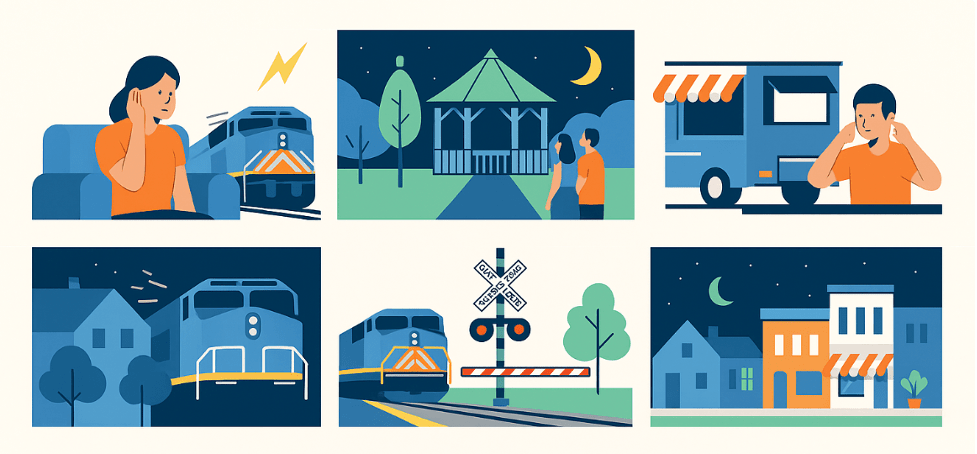
Each year, Ruston endures over 160 hours of blowing train horns; the equivalent of a full week of nonstop noise. They roll through like clockwork, sometimes adding a bit of charm, and sometimes perfectly timing their horns to hail an amen at the end of a sermon. But can you imagine: events at Railroad Park without piercing interruptions, hanging out at the food truck park without having to plug your ears, and classes at Tech that don’t have to stop mid-sentence for the train to pass.
I know we have all asked at one point or another; do the trains have to blast their horns so loud (and long), both night and day? The answer is yes, unless we put the time and money into addressing the situation.
By law, trains have to begin blowing their horns 15–20 seconds before they cross a road, unless the area is officially designated as a Quiet Zone by the Federal Railroad Administration (FRA). A Quiet Zone is a stretch of track where trains don’t have to announce themselves because adequate safety measures are in place to warn people that they are coming, and to stop people from trying to cross the tracks at the last moment. Only a city, parish, or other public authority that’s in charge of traffic control can apply to set one up.
Quiet Zones are attained by achieving a passing score per the Nationwide Significant Risk Threshold (NSRT) rating. The FRA starts by accumulating traffic, train, and accident data for each crossing, then applies the risk-reduction value of any Supplemental Safety Measures (SSMs) the city has in place. The zone’s score must be equal to or lower than the NSRT.
Common Supplemental Safety Measures include:
• Raised Medians – Long, heavy-duty center dividers that make it physically impossible for a driver to swerve into the opposite lane to go around lowered gates.
• Wayside Horns – Horns mounted at the crossing that aim sound toward approaching traffic instead of blasting the whole neighborhood.
• Four-Quadrant Gates – Gates that block all lanes in both directions so no car can sneak through.
• One-Way Street Conversions – Reducing traffic to a single lane in one direction, paired with other measures.
• Permanent Crossing Closures – Removing a street crossing entirely where alternate routes exist.
• Pedestrian Safety Systems – Gates, lights, and audible alerts for sidewalks and trails at crossings.

Example of a Raised Median.
The FRA’s flexible system means Ruston can choose the right balance of safety, budget, and traffic flow, and still meet the Quiet Zone standards. AKA, there is no “one right way” to do it.
A logical starting point for a Quiet Zone in Ruston could begin at Tech Drive and end after the Bernard Street crossing. In this span we have four public crossings at grade: Vienna, Trenton, Monroe and Homer Street. Currently our Quiet Zone Risk Index rating for that span is 26,299.73. The NSRT is 15,488, meaning we need to lower our score by about 10,812 units.
The good news is, if raised medians were added to just Vienna and Trenton Streets, Ruston could achieve a satisfactory rating for an estimated $30,000, the cost of repaving those two intersections to add the medians and covering FRA coordination, according to the FRA’s Quiet Zone Calculator.
More good news, there are grant opportunities out there that could help offset the costs:
- Railroad Crossing Elimination (RCE) Grant Program – Supports new signals, protective devices, medians, signage, and other safety enhancements at crossings. Requires at least 20% local match, and grants generally aren’t under $1M unless used for planning.
- Consolidated Rail Infrastructure & Safety Improvements (CRISI) Grant –Designed to fund projects that enhance safety, efficiency, and rail infrastructure reliability, including at-grade crossing improvements. It’s discretionary and supports public-private partnerships.
- RAISE Grants (formerly BUILD/TIGER) – Covers multimodal infrastructure improvements with high safety and community impact. Projects like Quiet Zones—especially ones that boost downtown livability—can compete well here.
- State-Level Formula Funds – For example, the Highway Safety Improvement Program (HSIP) apportions funds through each State DOT. However, Quiet Zones themselves are not always eligible, as they are noise-mitigation measures, not straightforward safety treatments.
A Quiet Zone for Ruston isn’t just wishful thinking, it’s a feasible project that can draw on federal infrastructure support and position downtown as a safer, more livable place. And maybe make your next outing downtown a little more peaceful.
The next step for us, as residents, is to ask our city leaders: what are we doing to make this happen?
 Heart of the Piney Hills
Leave a comment